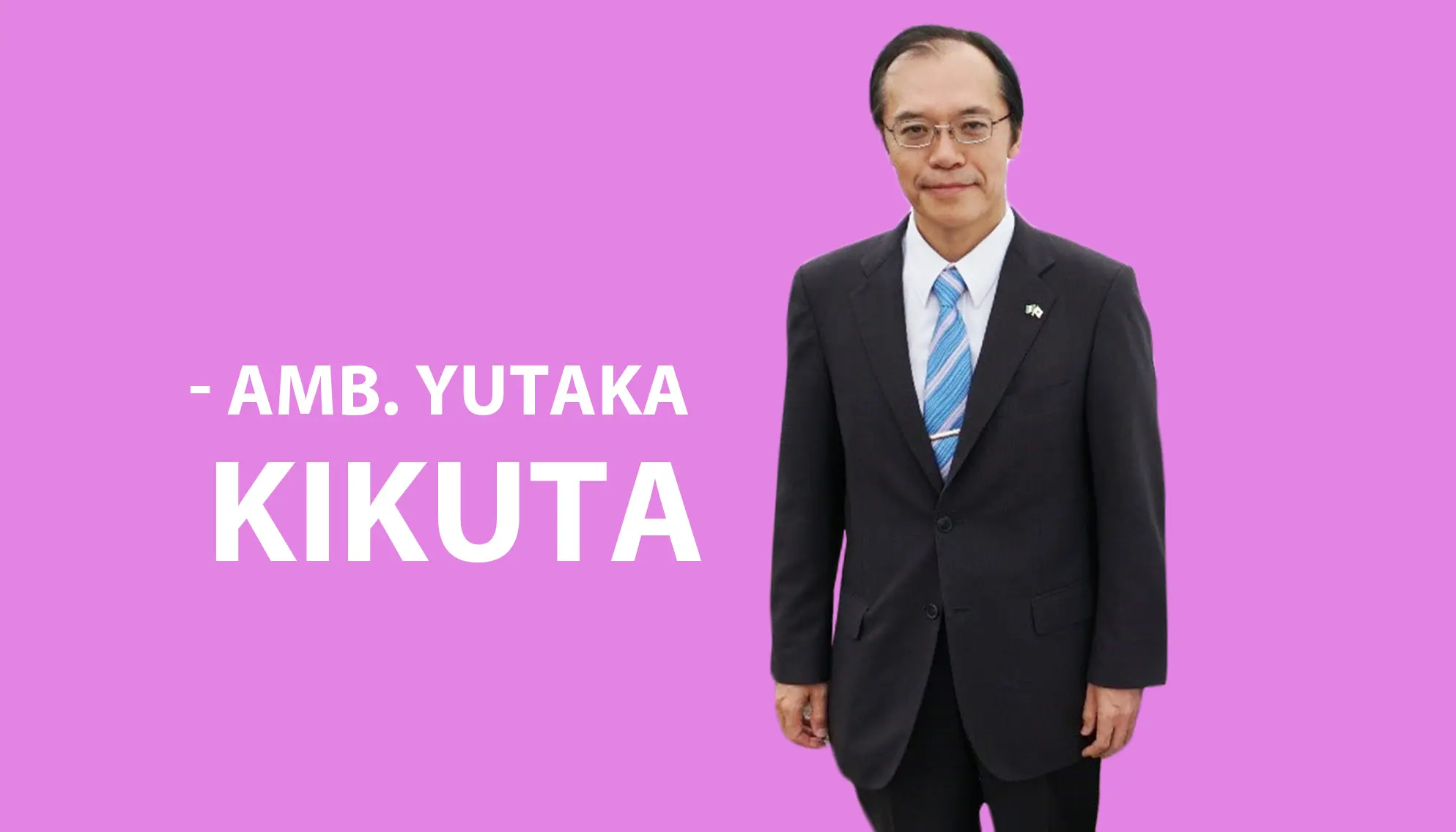
Japan has been a long standing ally to Nigeria dating back to the year 1960 when Nigeria gained her independence as a sovereign nation. In this Special Edition marking the Diamond Jubilee of the country, The Supremacy Magazine engaged His Excellency, Yutaka Kikuta, the Japanese Ambassador Extraordinary and Plenipotentiary to Nigeria on the relationship between both countries. The Ambassador also gave a deep insight on the role played by the Japanese Government towards the success story of Nigeria’s certification as a Wild Polio Virus free nation by the World Health Organization (WHO). Excerpts:
How will you assess diplomatic relations and future perspective between Japan and Nigeria as the country marks her 60th Independent Anniversary?
First of all, I have to start by congratulating Nigeria and Nigerians. Sixty years in the life of a nation is not a mean feat.
The year 1960 was called “the year of Africa”. Among the 17 African nations that gained independence from European countries that year, it was only Nigeria Japan established diplomatic relations with and actually opened its Embassy within the year. Since then, the Embassy of Japan has been solely in charge of Nigeria.
Therefore, this year marks the 60th anniversary not only of Nigeria’s independence but also of our close diplomatic ties. During these 60 years, Nigeria overcame the civil war and repeated military coups, making its best efforts to attain freedom and unity. Japan highly appreciates Nigeria’s progress in democracy. Japan regards Nigeria’s leadership as crucially important for the stability in the West African region and the development of the African continent as a whole.
When Nigeria was born 60 years ago, Japan was still a poor, war devastated island nation in the Far East. However, Japanese people worked hard for the reconstruction of its motherland, with massive loans and help from the World Bank and other development partners. We were grateful for the generosity from the world. At the same time, we learned that investment in human resources constitutes the basis of nation building. We would like to share our experience with other developing partners. Following the establishment of diplomatic relations in 1960, Japan extended its first loan assistance to Nigeria in 1966, first grant in 1970 and technical cooperation in 1972.
I am sure that based on our long-time friendly history, we will further build up our stable relationship in the coming future.
Can you share with us the experience of Japan with Covid-19 and how the country has been battling the pandemic? What is your message to the world as the battle against the virus continues?
Besides government policies and social infrastructure, I think the most important preventive measures are people’s mind and behavior. Japan was the first country that adopted and disseminated the concept of 3Cs; to avoid, 1. Closed spaces with poor ventilation. 2. Crowded places with many people nearby. 3. Close-contact settings such as close-range conversations. I am reminding the embassy staff, both diplomats and local staff, of the words of D’Artagnan from Les Trois Mousquetaires “Un pour tous, tous pour un: One for all, all for one.” I know in some countries people are demonstrating against compulsory use of face masks. To me, the point is not whether it is the people’s human right under the constitution not to wear a mask. The point is “whether you want to protect your loved ones around you”. Protecting yourself is protecting your neighbors. Japanese people are highly aware of this point and I wish people all over the world would follow that path. We need a worldwide collective effort in this fight.
Nigeria was recently certified Wild Polio Virus free status by WHO on August 25th. We realized that Japan played a prominent role in supporting Nigeria in the fight against polio. Can you share with us the role of the Japanese government in the success story? And why is polio eradication important to Japan?
Let me first express my heartfelt congratulations to all Nigerians as well as to the African people. As His Excellency President Muhammadu Buhari said at the 70th WHO regional committee for Africa, this achievement marked a truly historic moment.
I was glad to note the President referred in his statement to contributions made by the Government of Japan. We contributed the total amount of USD182.4 million for this feat. Among them, Japan provided a YEN loan equivalent of USD75.5 million from 2014 to 2017 in the form of a “loan conversion” in partnership with the Bill & Melinda Gates Foundation. This is unique and innovative in the sense that the Gates Foundation pays back to Japan according to the progress made by the Nigerian Government, thus the Nigerian Government incurs no financial burden.
This way, after the completion of the World Bank loan, most of the costs to procure polio vaccines were borne by Japan, taking a leadership role in the collective efforts among many international partners.
Why Japan? In the past, Japanese people too suffered gravely from this virus. I myself have friends and relatives who suffered from polio, some of whom still have lingering after effects.
But we knew the eradication of polio was an attainable goal because we had vaccines available. It might take many years of massive mobilization of people, but we knew that with determination and strenuous efforts of vaccination we could do it, together, like we did in the case of smallpox.
Therefore, after the eradication of polio from the Western Pacific region including Japan in 2000, Japan worked even harder to extend its experience to other parts of the world.
I should not forget to mention, however, that it was achieved through the collective efforts of Nigeria and the international community. I would like to thank, and to congratulate, all the organizations and people concerned.
How will Nigeria sustain the status of Wild Polio Virus Free country?
There are two more counties to go, i.e. Pakistan and Afghanistan, which are not yet free of Wild Polio Virus. Until the total eradication of the virus, including vaccine-derived polio, from the face of the earth, we have to remain vigilant. Polio Virus can easily be imported into a country and can spread rapidly among under-immunized populations. Therefore, as WHO cautions, vaccination efforts will need to continue alongside surveillance to protect children from being paralyzed by the disease in the future. There is no doubt that 25th August was a great milestone, but it is not the final destination.
With the successful eradication of Wild Polio Virus in the country, what other areas of development cooperation the Japanese government is extending to Nigeria, especially in the area of health?
The eradication of Wild Polio Virus is important, but it is just one example of Japan’s contribution. Japan has three pillars in its development cooperation policy towards Nigeria. First, economic development through infrastructure building, such as electricity, road, water and agriculture. Second, health sector such as universal health care and infectious disease control. Third, peace and stability including assistance for IDPs in the Northeast and capacity building to grapple with terrorism.
In the health sector, to mention but a few, all 36 Nigerian states and FCT have Japanese ambulances, each equipped with a ventilator and an oxygen tank, which are now useful when transporting Covid-19 patients. You can see infrared thermography in domestic airports, which were donated by Japan at the time of the Ebola hemorrhagic fever outbreak. I myself signed twice the Exchange of Notes to strengthen diagnostic capacity of NCDC and its network laboratories. These assistances were not originally planned as countermeasures of Covid-19, but I am proud that Japan’s long-term commitment to Nigeria’s health sector is now delivering results and saving lives in Nigeria.
Nigeria’s Leadership Role, Crucial to Stability of Africa – Amb. Kikuta
Comments