Special Report:
The ever improving Sino-Nigeria relations
Nigeria’s trade and diplomatic relations with the People’s Republic of China have overtime continued to grow in leaps
and bounds
Nigeria and the People’s Republic of China are among the most important nations of the world. The two countries are also
among the most populous in the globe. While the People’s Republic of China which is one of the world’s super powers has
a population of more than 1.4 billion, representing 18.54 % of the globe’s total, while Nigeria, a regional power has a
population of about 199million, which is 2.57 % of the world’s total. The two countries enjoy the best of relations in
trade, commerce and international diplomacy. Nigeria and the People’s Republic of China established formal diplomatic
relations on February 10, 1971 under the military government of Gen. Yakubu Gowon. Ever since, the People’s Republic of
China is considered one of Nigeria’s closest allies and trade partners.
Relations between the two nations grew closer as a result of the international isolation and Western stand against
Nigeria’s military regimes, from 1970s-1998. Nigeria has since become an important source of petroleum for China’s
rapidly growing economy and the African nation is looking to China for help in achieving high economic growth; China has
not disappointed as it has provided extensive economic, military and political support. In 2004 and again in 2006,
Chinese President Hu Jintao made state visits to Nigeria and addressed a joint session of the National Assembly. Both
nations then went on to sign a memorandum of understanding on establishing a strategic partnership. China has supported
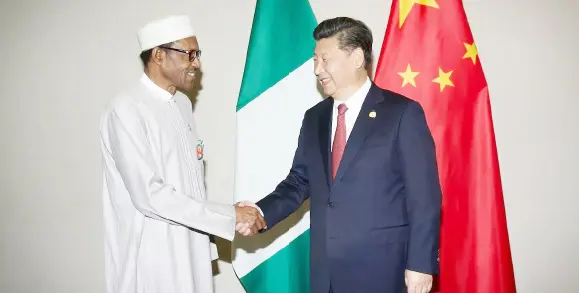
Nigeria’s bid for a seat in the UN Security Council. On April 10, 2016, Nigeria’s President, Muhammadu Buhari paid on
official visit to China in consolidation of the relationship between the two nations.
The Nigerian leader, during the visit, expressed satisfaction with the outcome of his trip to the Asian nation, which
has yielded additional investments in Nigeria.
President Buhari believes that the several agreements concluded with the Chinese during the visit will have a huge and
positive impact on key sectors of the Nigerian economy including power, solid minerals, agriculture, housing and rail
transportation.
In the power sector, North South Power Company Limited and Sinohydro Corporation Limited signed an agreement valued at
$478,657,941.28 for the construction of 300 Mega Watts solar power in Shiroro, Niger State.
In the solid minerals sector, Granite and Marble Nigeria Limited and Shanghai Shibang signed an agreement valued at $55
million for the construction and equipping of granite mining plant in Nigeria.
A total of $1 billion is to be invested in the development of a Greenfield Expressway for Abuja-Ibadan-Lagos under an
agreement reached by the Infrastructure Bank and Sinohydro Corporation Limited.
For the housing sector, both companies also sealed a $250 million deal to develop an ultra-modern 27-storey high rise
complex and a $2.5 billion agreement for the development of the Lagos Metro Rail Transit Red Line project. Other
agreements announced and signed during the visit included a $1 billion for the establishment of a Hi-tech industrial
park in Ogun-Guangdong Free Trade Zone in Igbesa, Ogun State. Furthermore, the Ogun-Guangdong Free Trade Zone and CNG
(Nigeria) Investment Limited also signed an agreement valued at $200 million for the construction of two 500MT/day float
gas facilities. An agreement valued at $363 million for the establishment of a comprehensive farm and downstream
industrial park in Kogi state was also announced at the Nigeria-China business forum.
Other agreements include a $500 million project for the provision of television broadcast equipment and a $25 million
facility for production of pre-paid smart meters between Mojec International Limited and Microstar Company Limited.
About 100 Nigerian businesses and 300 Chinese firms participated in the Nigeria-China business forum which took place a
day after President Buhari began his visit to China.
Former Director-General of the Nigerian Institute of International Affairs (NIIA) Prof Bola Akinterinwa, in a paper
delivered at the Africa Today’s summit on China-Africa relations examines President Muhammadu Buhari’s visit to China.
He said President Buhari’s first visit to China as President of Nigeria was one of the most profound and beneficial in
the history of the nation. He stated that the four-day State Visit was aimed at “enhancing bilateral relationship with
China and securing the support of the Chinese for Nigeria’s development agenda and it was for this purpose that the
President led a high-level delegation to China.”
These were not all. On Wednesday, April 13, 2016, Chinese President, Xi Jinping, offered Nigeria a $15 million
agricultural assistance for the establishment of 50 demonstration farms across the country. The President and Chief
Executive of the Dangote Group, Aliko Dangote, the Chairman of the Industrial and Commercial Bank of China (ICBC), Mr.
Jianqing and the Chairman of China Export and Credit Insurance Corporation (SINOSURE), Mr. Wang Yi signed a $2 billion
loan from the Industrial Commercial Bank of China Limited for two cement plants in Beijing.
Additionally, the Nigeria-China currency swap deal is another issue currently generating controversies in the print and
electronic media. Currency swap is an arrangement by which countries facing foreign currency liquidity challenges agree
to trade in their own local currencies, at a negotiated and pre-determined rates of exchange without the use of a third
currency. As noted by Joseph Uwaleke, there has been an increasing currency swaps agreements by Central Banks, following
the financial crisis of 2008. The currency swap agreements generally are done for three years and are meant to stabilise
the international financial market as well as facilitate bilateral trade and investment. According to Lin Songtian,
Director General of the African Affairs Department of the Ministry of Foreign Affairs in Beijing, the currency swap
‘means that the renminbi (Yuan) is free to flow among different banks in Nigeria and the renminbi has been included in
the foreign exchange reserves of Nigeria. ‘In the same vein, Godwin Ifeanyi Emefiele, Governor General of the Central
Bank of Nigeria, explained that ‘the agreement on the currency swap with China will definitely benefit Nigeria because
the essence of the mandate is to ensure that Nigeria is designated as the trading hub with China in the West African
sub-region for people who want the renminbi as a currency denomination.’ He noted further that ‘using the renminbi will
improve trade with China, as this will encourage importers to open Letters of Credit in the Chinese currency for the
importation of raw materials, equipment and machinery from China, rather than other trading regions, so the agreement
will encourage trade between countries.”
Johnson Chukwu, Chief Executive of the Cowry Asset Management Limited, a Nigerian Financial Advisory and Research Firm,
also has it that ‘about 22% of Nigeria’s exports will be settled in the Yuan instead of the US dollar, which will
relieve the country of much pressure on foreign reserves at this time.’
He said “We believe, and strongly too, that the present state of Nigeria-China relations, and particularly President
Buhari’s visit to China is mutually benefitting. At the level of China, the Chinese are seeking to assert themselves as
a global power. They want to grow their economy. They want their currency, the Yuan, to have the same international
value and impact in international financial relations. Nigeria is internationally recognized as a terra cognita for
profitable business and genuine and honest business investors. China is therefore much interested in Nigeria. Without
doubt, the Chinese are also actually indirectly challenging the domination of the US dollar and leadership in global
affairs.
To cement the existing relationship between the two countries, Muhammadu Buhari, in September last year headed to the
triennial Forum on China-Africa Co-operation in Beijing to pursue an additional $6bn in infrastructure loans from
Chinese state banks. At the two-day summit, Xi Jinping, China’s president, pledged $60bn for development across Africa.
Over the past decade, Chinese state banks and contractors have helped build a 186km rail line between the cities of
Abuja and Kaduna, with another line between Lagos and the northern city of Kano under construction. China Civil
Engineering Construction Corporation is working on the new international terminals for Nigeria’s four largest airports.
That of Abuja was completed and commissioned last year.
“From agriculture to transportation, China has helped rebuild rail lines, roads and bridges that Nigeria could not do
itself,” says Jonathan Coker, a former Nigerian ambassador to China. “The cost came out so much cheaper for us than
going to the traditional friends such as France, the UK and Canada.”
At the China and Africa Cooperation (FOCAC) in Beijing, in September last year President Buhari in the course of his
visit, held bilateral talks and witnessed the signing of some agreements between Nigeria and China in the areas of
Information and Communication Technology (ICT) and the economy. He also participated in the High-Level Dialogue between
Chinese and African leaders and business representatives.
At the FOCAC meeting, Buhari expressed the appreciation of ECOWAS member states for China’s increasing investment in the
sub-region with the aim of building a prosperous and shared future. He noted that China was the largest investor in the
sub-region in both private and public sectors, covering areas, such as infrastructure development in energy,
agriculture, mining and healthcare. According to him, China also provides significant assistance in emergency
humanitarian aid and response to climate change for Africa.
Buhari, at the FOCAC Round Table, attended by African leaders and Chinese President Xi Jinping, said Nigeria’s
partnership with China through FOCAC had resulted in the execution of vital infrastructure projects worth over five
billion dollars. Malam Garba Shehu, the Senior Special Assistant to the President on Media and Publicity, who was part
of the president’s entourage to China, said that Buhari won the crucial support of President Jinping, for Nigeria’s
aspiration to build the 3050 Megawatts Mambilla hydro-power project. He revealed that Nigeria and China also signed the
agreement of 328 million dollars for the Information and Communication Technology Infrastructure Backbone Phase II
(NICTIB II) project. The concessional loan agreement between Galaxy Backbone Limited and Huawei Technologies Limited
(HUAWEI) was signed by Nigeria’s former Minister of Finance Kemi Adesoun and Wang Xiaotoa, Director-General,
International Development Agency of China. The presidential aide disclosed that Nigeria and China also signed a
Memorandum of Understanding for the One Belt One Road Initiative (OBOR). In Beijing, Buhari also received assurances
from the Joint Venture Partners handling the 3050 Megawatts Mambilla Hydro-power Plant of which arrangements had reached
advance stage for the commencement of work early in 2019.
Buhari received the assurance when he was briefed on time lines for the commencement of work at a meeting with Prof. Lyu
Ze Xiang, the President of CGCC, the company handling the project. The president, at separate meetings with prospective
Chinese investors on the sidelines of FOCAC, assured existing and prospective Chinese investors of high-level support
for their investment plans in Nigeria. In all, the future belongs to the People’s Republic of China and the Federal
Republic of Nigeria.


Comments (2)
The whole world will run to China one day for rescue
China has found a money in Nigeria and Africa as a whole, reason they will never leave the continent